How to Choose Bathroom Tiles: A Sydney Designer's Guide
Choosing bathroom tiles isn't really about choosing tiles. It's about deciding how you want the most private room in your home to feel — and then making seven practical decisions that quietly bring that feeling to life.
Renovating a Sydney bathroom? Talk to our design team — free, unhurried, and tailored to your home.
Most people walk into our Rockdale showroom holding a Pinterest board, a half-formed idea about a colour, and a quiet worry that they're about to make an expensive mistake. That's a completely reasonable place to start. Bathroom tiles are one of the most permanent decisions in a renovation — they get specified before the room is built and live with you for fifteen, twenty, sometimes thirty years.
What we've learned across 26 years and thousands of bathrooms is that the people who end up happiest with their choice aren't the ones with the biggest budget or the most magazine clippings. They're the ones who answered the right questions in the right order. This guide walks through those questions the way our design consultants would walk you through them in person — with the practical context of slip ratings, sizes, grout, finish and flow, and the design context of how the whole room should feel when you're standing in it on a wet Tuesday morning.
Start with the feeling, not the tile
Before any swatches come off the shelf, our design team will usually ask one question: what do you want this bathroom to feel like? Calm and spa-like. Bright and energising. Quiet and textural. Warm and Mediterranean. Crisp and architectural. The answer determines almost everything that follows — the material, the palette, the scale of the tile, the finish, even the grout. A bathroom built around the wrong feeling looks correct on paper and never quite settles in real life.
If you can answer that question in a sentence, you're already most of the way through the hard part. Everything below is about translating the feeling into the right tile.
The seven questions our design consultants ask first
These are the seven decisions, in roughly the order we'd guide you through them. Each one narrows the field. By the time you reach the end, the tile choice usually feels obvious.
- Porcelain or ceramic?
- Where is the tile going — floor, wall, shower, or wet zone?
- What size and scale suits the room?
- What slip rating do you need?
- Matte, satin or gloss?
- What grout colour?
- How does this bathroom flow with the rest of your home?
1. Porcelain or ceramic?
For a bathroom, porcelain wins almost every time. Porcelain is denser and less porous than ceramic — it absorbs less than 0.5% of its weight in water, which means it doesn't need sealing and doesn't degrade in constant wet conditions. It's stronger underfoot, holds up to thermal expansion in heated floors, and is now manufactured in an extraordinary range of natural-stone, travertine, marble and concrete looks that genuinely rival the real thing.
Ceramic still has a place — primarily on walls in dry zones, for handmade-look feature tiles, and where a softer colour palette is wanted. But for any floor, any shower, and any surface that meets water regularly, porcelain is the more practical, more durable, and ultimately more cost-effective choice.
Travertine Soft Stone Porcelain
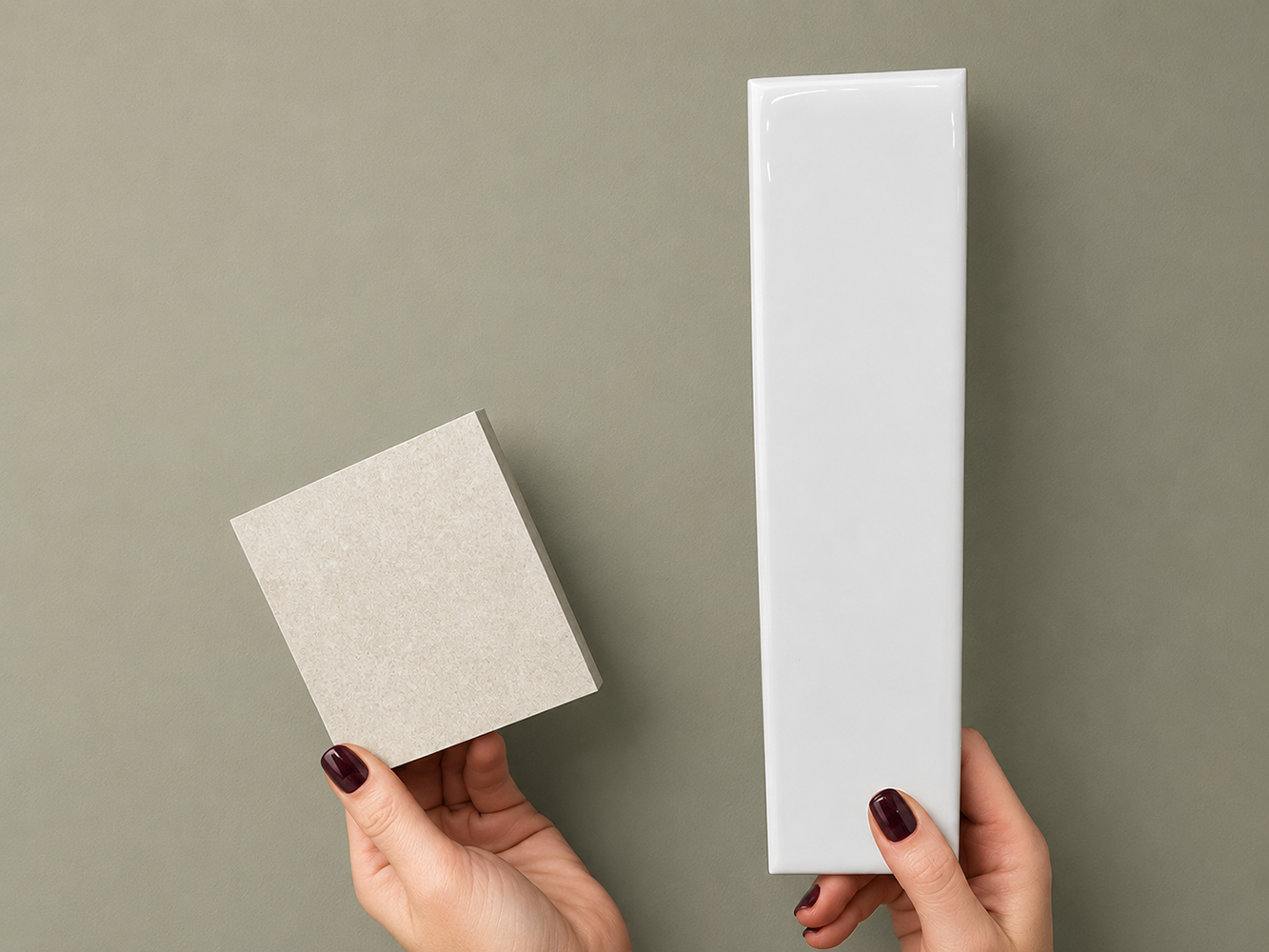
Warm beige with soft tonal variation, rectified edges, and the warmth of natural travertine with none of the sealing or maintenance. Floor and wall rated, available in 600×600 and 600×1200, plus a 600×1200 3D textured finish for feature walls.
View product →Avalon White Subway 75×300mm
Crisp white glazed ceramic in a slim 75×300mm subway format. Light-reflecting, dimensional, and adaptable to almost any palette — ideal when a bathroom needs a clean architectural wall feature.
View product →2. Floor or wall? The two tiles work differently
Not every tile is rated for every surface. Floor tiles need to be denser, thicker and slip-rated. Wall tiles can be lighter, thinner, and finished in ways — gloss, hand-glazed, mosaic — that wouldn't survive being walked on.
Many porcelain ranges now come with matching floor and wall versions of the same tile. That lets you run a single look across the entire room without compromising on performance. If you're tiling the shower floor, look specifically at the slip rating. The shower base sees the most water and the most barefoot traffic in the house.
3. What size and scale suits the room?
Large format porcelain — anything from 600×600 up to 1200×2800 panels — is the strongest current direction in Australian bathroom design, and it's not a passing trend. Fewer grout lines make a small bathroom feel calmer and more spacious, the surface reads as architectural rather than busy, and there is less to clean.
Smaller tiles and mosaics earn their place differently. They handle curves and falls beautifully, they grip better underfoot because of the extra grout lines, and they bring texture and personality to feature zones — niches, vanity walls, or the band behind a freestanding bath.
4. What slip rating do you need?
Slip rating is the most overlooked decision in residential bathrooms and the easiest one to get wrong. In Australia, tiles are tested under AS 4586 using the wet pendulum test, which produces a P-rating from P0 to P5.
| Where | Minimum P-rating | Equivalent R-rating |
|---|---|---|
| Bathroom floor, general | P3 | R10 |
| Shower floor or wet zone | P4, with P5 preferable | R11–R12 |
| Ensuite for elderly or accessible use | P4 minimum | R11 |
| Outdoor, pool surround or alfresco | P5 | R12–R13 |
Commercial bathrooms have stricter requirements under the National Construction Code. For residential, these are sensible minimums. Every tile we sell carries its rating clearly, and our team will always check it against your specific use before you commit.
5. Matte, satin or gloss?
Finish affects slip resistance, light and maintenance — in that order of importance. Matte and satin finishes are generally safer underfoot when wet, hide watermarks and soap residue better, and read as calmer and more contemporary.
Gloss bounces light and is wonderful on walls, particularly in small bathrooms or in feature zones where you want a tile to catch attention. A common, well-considered combination is a matte porcelain on the floor and main walls, with a satin or hand-glazed gloss in the shower niche, behind the vanity or as a feature band.
6. What grout colour?
Grout is the detail that quietly makes or breaks a bathroom. Too dark and it draws every grid line into focus. Too white and it stains, ages quickly and starts to feel like a cheap rental.
The reliable designer move, and the one we recommend in most cases, is a warm soft grey — usually two shades darker than the tile, blended just enough that the grid recedes but the tile reads as deliberate rather than monolithic.
7. How does this bathroom flow with the rest of your home?
This is the question most online tile stores can't help with, and it's the one that separates a good bathroom from a bathroom that quietly elevates the whole house. A bathroom shouldn't match the rest of your home — but it should belong to it.
The same warm neutral family. A material that connects to the kitchen splashback or the floors. A finish that picks up the tapware or joinery elsewhere. When we plan a renovation in the showroom, we look at the whole house together: kitchen, laundry, ensuite, main bath and alfresco.
The mistake we see most often
The most common renovation mistake we see has nothing to do with choosing the wrong tile. It's choosing the right tile in the wrong order. Renovators often lock in tapware and stone benchtops first, then come looking for a tile to fit.
The order we recommend is the reverse. Tile first — because it's the largest surface area in the room, the hardest to change, and the most expressive choice you'll make. Then stone, then tapware, then joinery, then paint.
"Tile first. It's the largest surface, the hardest to change, and the most expressive choice in the whole bathroom. Every other decision follows it more easily than the other way around."
How we help you get it right at our Rockdale showroom
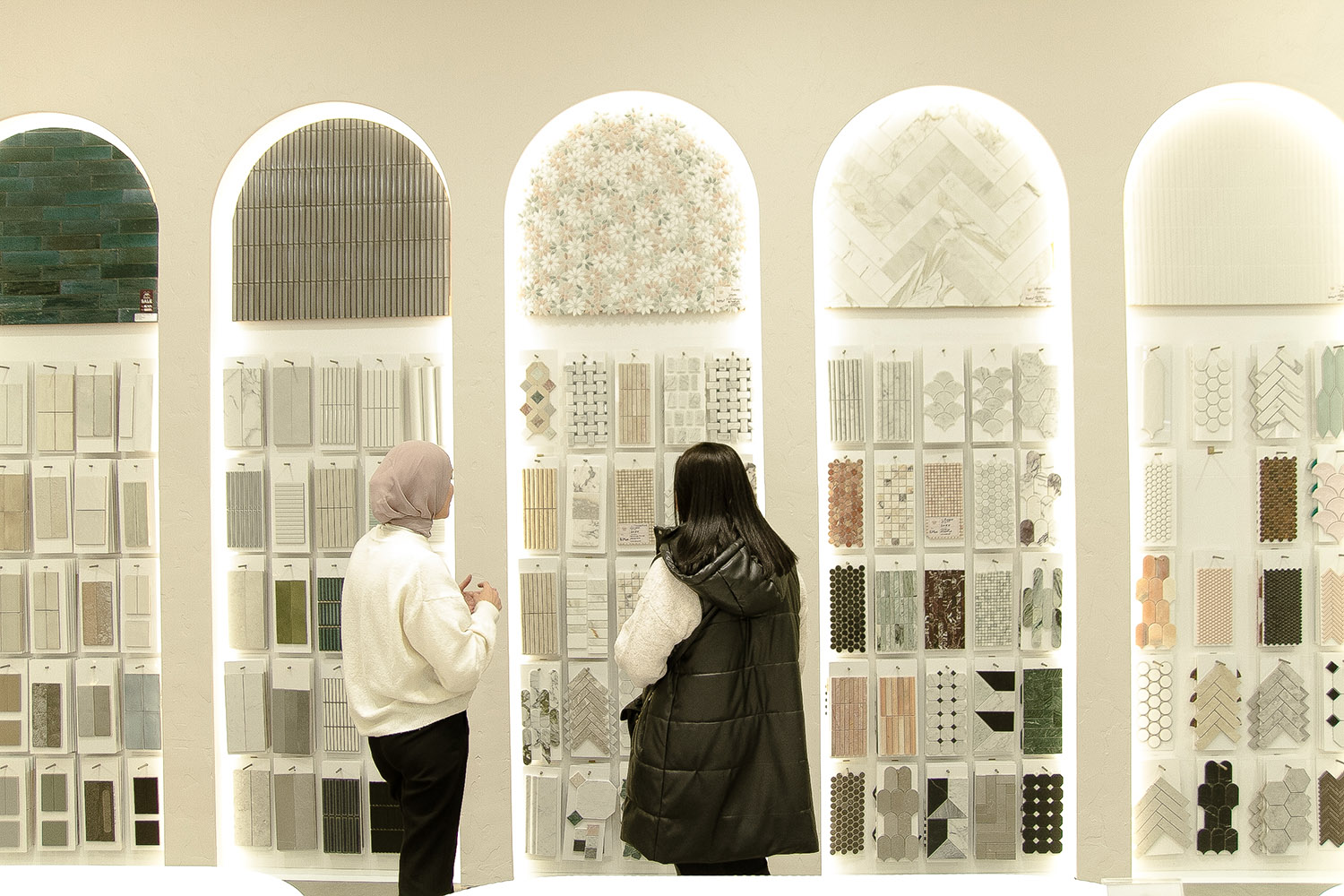
Choosing tiles in person is genuinely different to choosing them online. Colour shifts under different lighting. Texture only reveals itself in your hand. Two tiles that look identical on a phone screen can sit completely differently against your stone, your timber or your tapware.
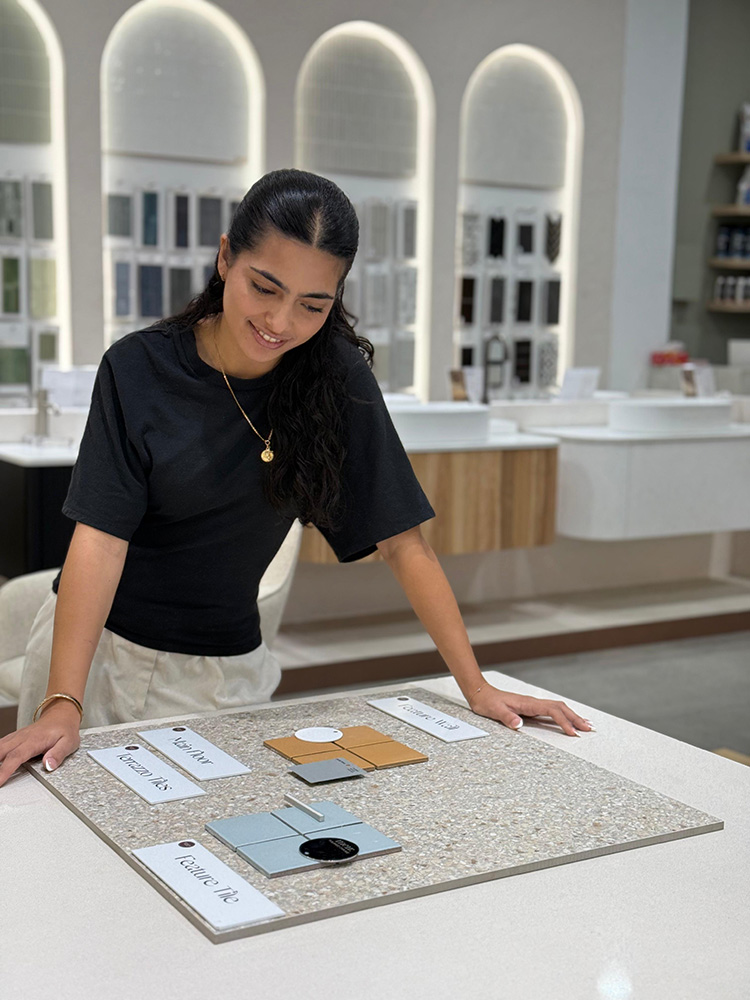
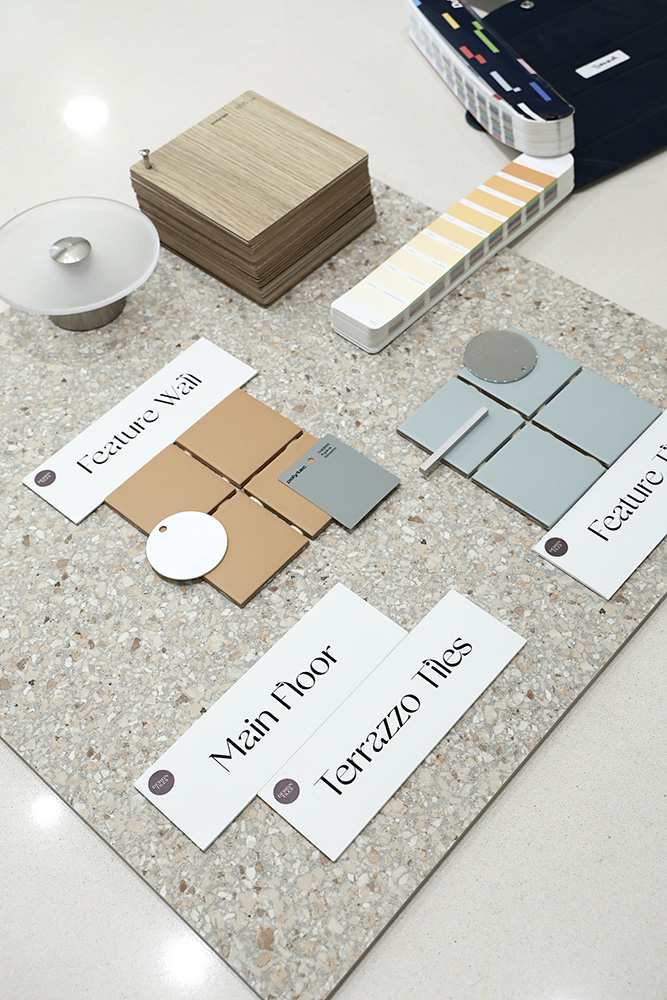
Our showroom is set up specifically for this — large samples in real light, flat lays built on the table in front of you, vanities and bathware in full configuration so you can see how a palette settles together rather than guessing from thumbnails.
Frequently asked questions
What is the best type of tile for a bathroom?
Porcelain is the best all-round bathroom tile. It is denser and less porous than ceramic, holds up to constant moisture without absorbing water, doesn't need sealing, and is available in finishes that mimic natural stone, travertine, marble and concrete. Ceramic is still suitable for walls in dry zones, but porcelain is the more reliable choice for floors and wet areas.
What slip rating do I need for a bathroom floor?
For a residential bathroom floor in Australia, a P3 wet pendulum rating is generally considered the minimum for safety in wet areas. For showers, ensuites used by elderly family members, and any indoor-to-outdoor wet zones, P4 or P5 is preferable. Around pools and external alfresco areas, P5 is the standard.
Are large format tiles a good idea for a small bathroom?
Yes, often. Large format tiles reduce the number of grout lines, which makes a small bathroom feel calmer, more spacious and easier to clean. The key constraints are that the substrate needs to be very flat for large formats to install well, and very small or oddly-shaped rooms can result in more wastage from cuts.
What is the best grout colour for a bathroom?
There is no single right answer. As a designer's default, a warm soft grey or a colour two shades darker than the tile gives a calm, contemporary look that ages well and hides everyday marks. Matching grout creates a seamless, monolithic finish. High-contrast grout makes a strong graphic statement but is harder to live with long-term.
Can I use the same tile on the floor and walls?
Yes — running one tile across the floor and walls is a popular contemporary look that creates a calm, sanctuary-like bathroom. The tile must be floor-rated, and you'll typically still want enough variation in finish, texture or scale elsewhere in the room to avoid the space feeling flat.
How many bathroom tile designs should I use in one room?
A reliable rule is no more than three. A common combination is a floor tile, a main wall tile, and a feature tile used in the shower niche, behind the vanity or as a band of mosaic. Anything more and the room starts to feel busy.
Are matte tiles better than gloss for bathrooms?
Matte and satin finishes are generally preferred for bathroom floors because they are less slippery when wet and hide watermarks better. Gloss is best reserved for walls, where it bounces light and makes small bathrooms feel brighter.
Do bathroom tiles need to be sealed?
Porcelain tiles do not need to be sealed because they are non-porous. Natural stone tiles — marble, travertine and limestone — do need sealing on installation and periodic re-sealing thereafter. Grout always benefits from a sealer to prevent staining and mould.
Should bathroom tiles match the rest of the house?
They don't need to match, but they should belong. Using the same tile family across bathroom, laundry and ensuite creates a calm visual flow. Many travertine-look porcelain ranges have matching indoor and external versions specifically for this kind of whole-home cohesion.
How much do bathroom tiles cost in Sydney?
In Sydney, bathroom tiles range from around $30 per square metre for basic ceramic to $250+ per square metre for premium European porcelain and natural stone. As a guide, mid-range designer porcelain typically sits between $60 and $120 per square metre. Installation, waterproofing and substrate preparation are separate costs.

Bring your bathroom to life with us
Book a free consultation with our design team, or visit our Rockdale showroom to see, touch and pair real samples in real light. No pressure, no obligation — just thoughtful guidance.